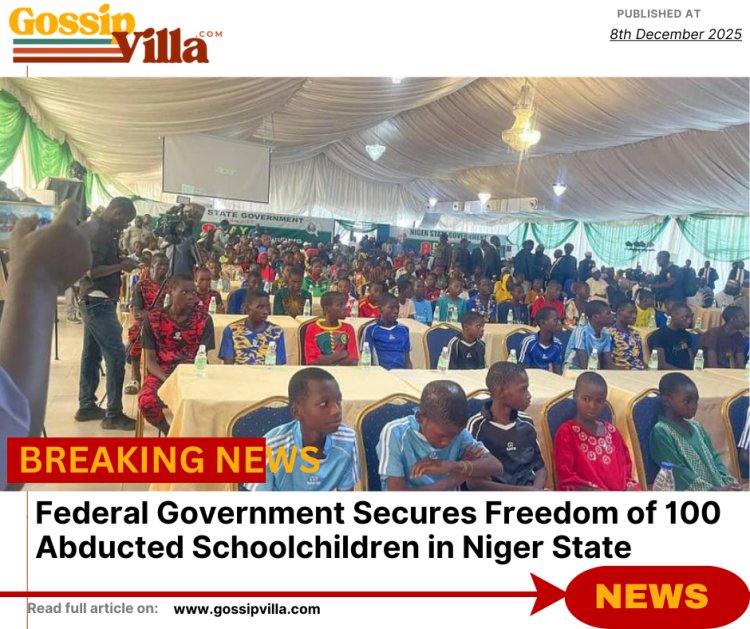
Federal Government Secures Freedom of 100 Abducted Schoolchildren in Niger State
Federal Government secures freedom of 100 schoolchildren abducted from St. Mary’s Catholic School in Papiri, Niger State on Nov 21, 2025. 153 pupils & 12 teachers still held.
Federal Government Secures Freedom of 100 Abducted Schoolchildren in Niger State:
A Glimmer of Hope Amid Nigeria’s Security Crisis
In a nation long scarred by the shadows of insecurity, where the echoes of gunfire and desperate pleas for ransom have become tragically commonplace, a ray of hope pierced through the darkness this weekend. The Federal Government of Nigeria has reportedly secured the release of 100 schoolchildren abducted from St. Mary’s Private Catholic Primary and Secondary School in Papiri, Agwara Local Government Area of Niger State.
This development, announced by local broadcaster Channels Television, marks a significant, albeit partial, victory in the fight against the banditry that has terrorized the country’s northwest. Yet, as families rejoice over the safe return of their little ones, the grim reality lingers: 153 pupils and 12 teachers remain in captivity, their fates hanging in the balance. This incident is not just a headline it’s a stark reminder of the human cost of Nigeria’s enduring security challenges and the urgent need for systemic reform.
The abduction unfolded like a nightmare on the night of November 21, 2025, when a horde of gunmen stormed the serene premises of St. Mary’s Catholic boarding school. According to the Christian Association of Nigeria (CAN), the attackers, believed to be bandits operating from the dense forests bordering Niger, Kwara, and Kebbi states, rounded up 303 students some as young as six years old and 12 school staff members. The assailants, armed with rifles and moving with ruthless efficiency, herded their captives into the night, vanishing into the labyrinthine terrain that has long served as a haven for such criminal elements. In the chaotic aftermath, about 50 pupils managed to escape, slipping away in the ensuing hours through sheer luck and bravery, reuniting with their distraught parents under the cover of darkness. But for the remaining 265, silence reigned, broken only by the anguished cries of families and the flickering hope of a nation weary from similar horrors.
Eyewitness accounts from the school compound paint a harrowing picture. “The gunshots started around 10 p.m.,” recalled one escaped student in a statement relayed through CAN spokespersons. “They came from the bushes, shouting orders in Hausa. We ran, but many were caught. The teachers tried to protect us, but there were too many of them.” The school’s proprietor, Most Rev. Bulus Yohanna, Bishop of the Kontagora Diocese, described the scene as “heart-wrenching,” with classrooms left in disarray overturned desks, scattered books, and the faint scent of fear lingering in the air. Papiri, a quiet hamlet nestled in the agrarian heart of Niger State, is no stranger to insecurity. Bandits have long exploited the region’s porous borders and vast forests for kidnappings, cattle rustling, and extortion, turning what should be a cradle of learning into a frontline of terror.

The Federal Government’s response was swift, though details of the operation remain shrouded in the typical veil of security secrecy. Following the abduction, President Bola Tinubu’s administration mobilized a multi-agency task force, including the Nigerian Army, Police, and Department of State Services (DSS). A 24-hour cordon was imposed across the tri-state axis, bolstered by aerial surveillance from helicopters and drones.
Community hunters and local vigilantes joined the fray, combing the underbrush for clues. Presidential spokesperson Sunday Dare confirmed the release to AFP, hinting at “intense negotiations and tactical interventions” but stopping short of specifics likely to avoid jeopardizing efforts for the remaining hostages. The 100 freed children are scheduled for handover to Niger State officials on Monday, where they will undergo medical evaluations and psychological counseling. Early reports suggest they are in stable condition, though the trauma of weeks in captivitymarred by hunger, fear, and isolation will undoubtedly leave lasting scars.
This partial rescue comes at a pivotal moment for Nigeria’s security landscape. Over the past decade, the country has grappled with a surge in mass abductions, particularly targeting schools as symbols of vulnerability and leverage for ransom. The infamous 2014 Chibok kidnapping by Boko Haram, where 276 girls were seized, set a grim precedent, with over 100 still missing today. More recently, the July 2021 Bethel Baptist School abduction in Kaduna saw 140 students taken, and just last year, 287 schoolchildren were freed in Kuriga after a government operation. Yet, these victories are pyrrhic; for every child returned, countless others vanish into the ether of Nigeria’s “kidnap economy,” where armed groups extort millions in ransoms annually. (CNN NEWS)
What drives this scourge? At its core, banditry in the northwest stems from a toxic brew of poverty, unemployment, and weak governance. Niger State, with its fertile lands and proximity to the capital Abuja, ironically bears the brunt due to under-policed rural expanses. Armed groups, often loosely affiliated with Islamist insurgents like Boko Haram or ISWAP, exploit ethnic tensions between Fulani herders and sedentary farmers, escalating minor disputes into full-blown criminal enterprises. Climate change exacerbates the crisis, as desertification forces herders southward, clashing with communities over scarce resources. The United Nations has estimated that over 1.5 million people in the region are internally displaced, many fleeing such violence, which in turn fuels recruitment into bandit ranks.
The St. Mary’s incident has amplified international scrutiny on Nigeria’s human rights record, particularly concerning religious minorities.
As a Catholic institution in a predominantly Muslim area, the school attack has drawn accusations of targeted persecution against Christians a narrative amplified by U.S. President Donald Trump’s recent threats of military intervention over alleged ill-treatment of Christian communities. On Sunday, a U.S. congressional delegation met with National Security Adviser Nuhu Ribadu in Abuja to discuss counter-terrorism and regional stability, underscoring the global stakes. Domestically, opposition voices, including the People’s Democratic Party (PDP), have lambasted the Tinubu administration for “security lapses,” demanding a full inquiry into how such a large-scale breach occurred under the nose of federal forces.
For the families of the freed children, however, politics takes a backseat to profound relief. “We have been praying non-stop,” said one mother, clutching a photo of her seven-year-old daughter, in an interview with local media. “When I heard the news, I collapsed in tears of joy. But my heart aches for those still out there.” Bishop Yohanna echoed this sentiment, expressing cautious optimism while urging the government to expedite the release of the others. “These are innocent souls, entrusted to us by God. Their freedom is not negotiable,” he stated, calling for accelerated rescue operations. CAN’s Niger State chapter, through spokesperson Daniel Atori, emphasized the need for community healing, with prayer vigils planned across churches in the coming days.
Looking ahead, this event underscores the imperative for holistic solutions beyond reactive rescues. Experts advocate for a multi-pronged approach: bolstering intelligence-sharing among security agencies, investing in rural infrastructure like better roads and schools to deter bandit incursions, and addressing socioeconomic drivers through youth employment programs and conflict mediation between herders and farmers.
The government’s recent launch of the National Livestock Transformation Plan, aimed at modernizing pastoralism, could be a step forward if properly funded and implemented. Moreover, international partnerships such as those with the U.S. and UN must evolve from rhetoric to tangible support, including training for local forces and humanitarian aid for displaced families.
READ MORE ON : Gunmen Abduct More Than 200 Students and Staff from St. Mary’s Catholic School in Niger State, Nigeria
The release of these 100 children is a testament to resilience, the unyielding spirit of Nigerian families, the dedication of security personnel risking their lives in unforgiving terrain, and the quiet diplomacy that often unfolds behind closed doors. Yet, it is also a clarion call. As the sun rises on Papiri tomorrow, with the freed children stepping back into the arms of their loved ones, Nigeria must confront the unfinished business of security. The remaining 165 captives are not statistics; they are dreams deferred, futures on hold.
Their freedom demands not just prayers, but action decisive, sustained, and inclusive.
In the words of Bishop Yohanna, “Hope is our anchor, but justice is our sail.” May this partial triumph propel the nation toward calmer waters, where no child fears the classroom and every dawn brings safety, not sorrow.
What's Your Reaction?