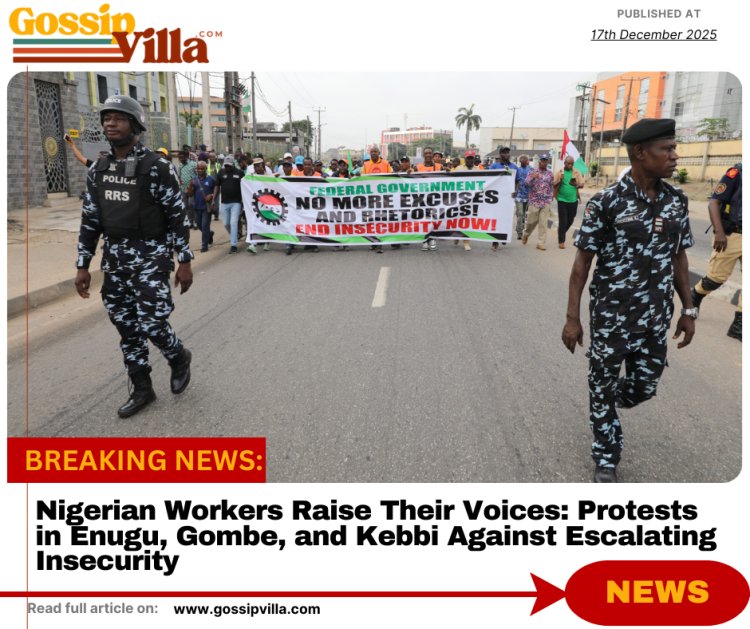
Nigerian Workers Raise Their Voices: Protests in Enugu, Gombe, and Kebbi Against Escalating Insecurity
On December 17, 2025, thousands of Nigerian workers under the Nigeria Labour Congress (NLC) staged peaceful protests in Enugu, Gombe, Kebbi, and across the country against escalating insecurity, including banditry, kidnappings, and terrorism. The rallies highlighted the government’s failure to protect citizens, with demands for urgent action to safeguard lives, schools, and livelihoods.

Nigerian Workers Raise Their Voices: Protests in Enugu, Gombe, and Kebbi Against Escalating Insecurity
On December 17, 2025, thousands of Nigerian workers affiliated with the Nigeria Labour Congress (NLC) took to the streets in a coordinated nationwide demonstration against the country’s worsening insecurity. While protests occurred in multiple states and the Federal Capital Territory, the actions in Enugu, Gombe, and Kebbi stood out for their intensity, organization, and direct messaging to local authorities. These peaceful rallies underscored a growing frustration among ordinary citizens—particularly workers—who feel abandoned amid rampant banditry, kidnappings, and terrorism that have plagued Nigeria for years.
The NLC’s decision to mobilize stemmed from a National Executive Council meeting on December 4, 2025, where leaders expressed alarm over the daily threats to workers’ lives and livelihoods. Incidents like the November 17, 2025, abduction of 24 schoolgirls in Kebbi State—during which two staff members were killed after security personnel were reportedly withdrawn served as stark reminders of the crisis. The union described the protests as a “collective act of grief” and a demand for the government to fulfill its primary duty: protecting lives and property.
The Spark: Why Workers Are Protesting
Nigeria’s insecurity crisis is not new, but it has intensified, affecting every sector of society. Bandits and terrorists have displaced millions, disrupted agriculture, and targeted schools, markets, and highways. Workers, including teachers, health professionals, and civil servants, bear a disproportionate burden. Many have been kidnapped for ransom, killed, or forced to flee their jobs. The NLC highlighted how this violence exacerbates poverty with over 139 million Nigerians in multidimensional poverty according to recent World Bank reports and hampers economic productivity.
According to Punch News, NLC President Joe Ajaero emphasized that workers lack the means to pay ransoms and often resort to borrowing or begging. “It is important for workers to join the call to end insecurity,” he said during a visit to Gombe ahead of the protests. The demonstrations also tied into broader grievances, including the rising cost of living and unresolved agreements with the federal government.
Despite a late-night meeting with President Bola Tinubu on December 16, where labour leaders discussed these issues, the NLC proceeded with the protests, viewing them as essential to press for urgent reforms.
Protests on the Ground: State-by-State Highlights
In Enugu, the protest was vibrant and vocal. Led by State Chairman Fabian Nwigbo, workers marched through major roads, chanting solidarity songs and displaying placards with messages like “Nigeria is bleeding,” “End terrorism, banditry and kidnapping now,” and “Poverty fuels insecurity create jobs, support local industries.” Nwigbo addressed the crowd passionately: “The environment is not safe for anybody in Nigeria. Our school children are not safe, teachers are not safe, workers are not safe, farmers are not safe, travellers are not safe. Nobody is safe anywhere.” He extended the criticism to the political class, noting that even they face kidnappings and attacks. “We are saying capital NO to insecurity. Enough is enough,” he declared, positioning the NLC as the “mouthpiece of the people.”
The Enugu rally captured the raw emotion of workers who feel the crisis has reached intolerable levels, with no corner of society spared.
In Gombe, the approach was more formal. Workers arrived in a convoy of vehicles at the office of the Deputy Governor, where State Chairman Yusuf Bello presented a detailed letter to Governor Muhammadu Yahaya. Titled “Why Workers Are Protesting Against the Rising Wave of Insecurity in Nigeria and the Way Forward,” the document outlined two decades of persistent threats banditry, kidnappings for ransom, and terrorism that have displaced millions and crippled agriculture. It cited devastating statistics: destroyed schools and healthcare facilities, killings and abductions of workers, and the mass exodus of professionals, especially in the North-East.
Bello stressed that insecurity transcends religion, ethnicity, and occupation, impacting livelihoods, education, healthcare, and overall development. He reminded authorities that protecting citizens is the government’s core responsibility, accusing the state of failing in this regard.
Meanwhile, in Kebbi, the event took the form of a solidarity rally rather than a full protest, reflecting the state’s relative calm compared to hotspots. Led by State Chairman Murtala Usman and involving affiliates like teachers, health workers, and journalists, participants gathered at the Labour House after a peaceful procession. Usman praised Governor Nasir Idris for addressing insecurity “squarely” but aligned with the national call for unity against the menace. The Kebbi Police Command deployed personnel to ensure peace, acknowledging the constitutional right to assemble while preventing potential hijacking by miscreants. ( Premium Times)
A Nationwide Echo with Heavy Security
Across Nigeria, police deployed special forces, tactical teams, and surveillance to maintain order. In many states, commands collaborated with labour leaders to ensure the events remained peaceful. The NLC urged participants to stay disciplined, framing the day as one of unity and shared grief.
READ MORE ON : #Free Mazi Nnamdi Kanu: Sowore Sparks Nationwide Protest for Justice
The Bigger Picture: Time for Action?
These protests in Enugu, Gombe, and Kebbi reflect a deeper national malaise. Insecurity not only claims lives but erodes trust in governance, deters investment, and perpetuates poverty. Workers, as the backbone of the economy, are demanding more than rhetoric, they want concrete measures: bolstered security in vulnerable areas, intelligence-led operations, community engagement, and socioeconomic interventions to address root causes like unemployment.
While the federal government’s engagement with labour leaders is a step forward, sustained action is crucial. As Nwigbo aptly put it, the NLC will “continue to speak, to stand and to fight for Nigerians.” Today’s rallies serve as a powerful reminder that silence in the face of crisis is no longer an option.
The voices from Enugu’s streets, Gombe’s formal submissions, and Kebbi’s solidarity march echo a unified call: Nigeria must secure its people to secure its future.
What's Your Reaction?