Nigeria Police Deploy Special Team to Enforce Ban on VIP Escorts
The Nigeria Police Force has deployed a Special Enforcement Team to strictly enforce the presidential ban on police officers serving as escorts and bodyguards for VIPs.

Nigeria Police Deploy Special Team to Enforce Ban on VIP Escorts
In a decisive move to reclaim the Nigeria Police Force (NPF) from the clutches of elite privilege, the Inspector-General of Police, Kayode Adeolu Egbetokun, has unleashed a Special Enforcement Team tasked with cracking down on the unauthorized use of police officers as personal bodyguards for Very Important Persons (VIPs). This initiative, launched today in Lagos, marks the first major field operation enforcing President Bola Tinubu’s sweeping directive issued just two weeks ago. As sirens fade from the motorcades of politicians, business tycoons, and celebrities, the nation watches to see if this ban can truly redirect scarce police resources toward the streets where they are desperately needed most.
The announcement came via an official statement from Force Public Relations Officer CSP Benjamin Hundeyin, who detailed the team’s monitoring exercise that kicked off at 10:00 AM across key Lagos hotspots, including the Lekki-Ikoyi Link Bridge and the Domestic Wing of Murtala Muhammed International Airport. Early reports are encouraging: no violations were spotted, no arrests made, and compliance described as “satisfactory and commendable.” Yet, beneath this calm surface lies a seismic shift in Nigeria’s security architecture one that challenges decades of entrenched corruption and resource misallocation.
The Genesis of the Ban: A Presidential Mandate for Change
The roots of this enforcement trace back to November 23, 2025, when President Tinubu convened a high-stakes security meeting in Abuja with service chiefs and the Director-General of the Department of State Services (DSS). Amid escalating concerns over banditry, terrorism, and urban crime, the President issued a no-nonsense order: withdraw all police personnel assigned to VIP escort and guard duties, and redeploy them to “core policing functions.” This wasn’t mere rhetoric; it was a clarion call to dismantle a system where over 100,000 officers roughly 40% of the force were tied up in private security roles, leaving ordinary citizens vulnerable.
Bayo Onanuga, the President’s Special Adviser on Information and Strategy, elaborated in a follow-up statement that VIPs in genuine need of protection would now turn to the Nigeria Security and Civil Defence Corps (NSCDC) for armed operatives. This pivot isn’t just logistical; it’s symbolic. “The police exist to serve the public, not the powerful,” Onanuga emphasized, underscoring the administration’s zero-tolerance stance on the commodification of law enforcement. (Daily post)
For context, Nigeria’s policing woes are no secret. With a police-to-citizen ratio of one officer per 650 resident far below the UN-recommended 1:220, the force has long been stretched thin. Reports from human rights groups like Amnesty International have lambasted the NPF for prioritizing VIP protection, often at the expense of investigating kidnappings, armed robberies, and communal clashes that plague regions like the North-West and South-East. Tinubu’s directive, therefore, arrives as a potential game-changer, aiming to infuse the force with renewed focus on community safety.
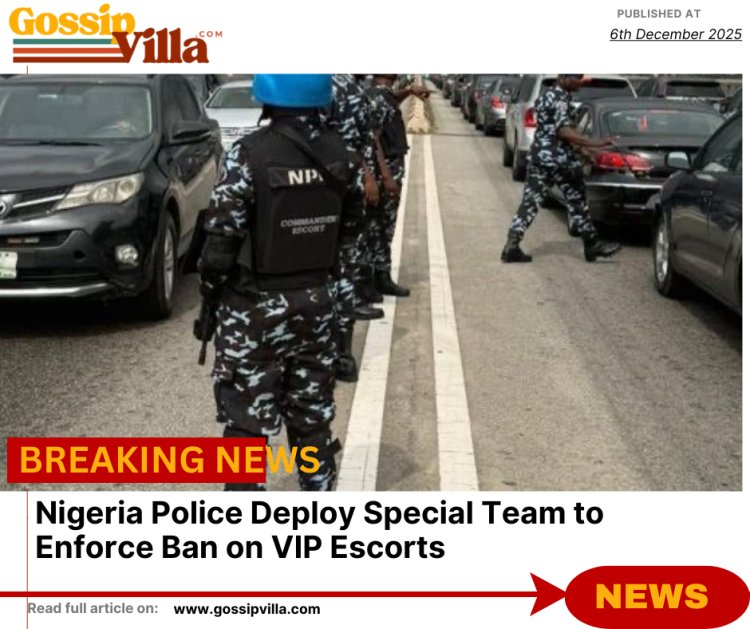
The Special Team in Action: From Abuja to the Streets
The deployment of the Special Enforcement Team is the enforcement arm of this policy, and it’s off to a robust start.
Punch News revealed that the team, comprising intelligence and provost officers, conducted patrols along major routes, scrutinizing vehicles for any sign of uniformed or plainclothes policemen moonlighting as escorts. Their mandate is clear: arrest any officer found in violation, disarm them on the spot, and haul them in for orderly room trials. Supervisors who turn a blind eye face equal scrutiny, with disciplinary actions promised without favoritism.
This isn’t isolated to Lagos. Earlier signals from Force Headquarters, dated November 30, 2025, ordered nationwide arrests, targeting airports, highways, and urban centers where VIPs are prone to flaunt their privileges. In Akwa Ibom, Commissioner of Police Baba Mohammed Azare wasted no time, directing Area Commanders and Divisional Police Officers (DPOs) to enforce the ban stringently, with threats of sanctions for lapses. Similarly, the Assistant Inspector-General overseeing the Special Protection Unit was instructed to station teams at Abuja’s Nnamdi Azikiwe International Airport, a notorious hotspot for illicit escorts.
A user update on X (formerly Twitter) painted an optimistic picture: “The Nigeria Police Force remains resolute in redeploying its personnel to core policing duties aimed at enhancing general security, crime prevention, and the protection of lives and property across the country.” But the proof will be in the pudding. Past attempts at reform, such as the 2020 EndSARS protests’ demands for accountability, have fizzled under political pressure. This time, the IGP’s personal stamp Ph.D. holder and no-nonsense reformer adds weight. Egbetokun has vowed “enforcement without fear or favour,” urging citizens to report sightings via hotlines or social media.
Why This Matters: Unpacking the Broader Implications
At its core, the VIP escort ban is about equity in a nation where the elite’s security often trumps the masses’. Imagine a scenario in Kaduna, where bandits raid villages unchecked while officers idle in Abuja mansions, or in Lagos, where traffic snarls from VIP convoys exacerbate daily commutes for millions. By freeing up thousands of officers, the NPF could bolster patrols in high-crime areas, invest in intelligence gathering, and even train more community-oriented units. Analysts estimate this could reduce response times to emergencies by up to 30%, based on similar reforms in countries like Kenya and South Africa.
Economically, the ripple effects are profound. VIP protection has long been a shadow economy, with reports of officers paying “settlement fees” to superiors for plum postings sometimes up to ₦500,000 monthly. Ending this could curb corruption, allowing promotions based on merit rather than bribes. Moreover, redirecting resources to the NSCDC, a corps already handling civil defense and anti-vandalism, promotes inter-agency synergy. It’s a model that could inspire federal-state collaborations, ensuring VIPs like governors and senators aren’t left defenseless but are served by a more specialized force.
Yet, the human element can’t be ignored. Officers accustomed to cushy VIP gigs complete with allowances and minimal risk may resist. Whispers of underground networks persisting in mufti (plainclothes) have already surfaced, prompting the Force’s preemptive warning against such subterfuge. For the public, this ban fosters trust: when police prioritize pothole patrols over politician pampering, it humanizes the force, potentially reducing the extrajudicial abuses that fuel protests.
Challenges Ahead: Navigating Resistance and Rollout
No reform is without hurdles. Critics, including some opposition figures, argue the ban could expose genuine threats to VIPs, from kidnapping rings targeting high-profile individuals to election-related violence. In a country where over 3,000 kidnappings were reported in 2024 alone, per police stats, the NSCDC’s capacity to absorb this load is untested. The corps, with about 50,000 personnel, lacks the NPF’s firepower and training in close-protection tactics. What if a VIP attack occurs? Fingers will point, and political capital could erode.
Implementation gaps loom large too. Rural commands, under-resourced and distant from Abuja’s oversight, might lag in compliance. Corruption watchdogs like the Independent Corrupt Practices Commission (ICPC) will need to monitor for loopholes, such as “authorized” exceptions creeping in via backdoor approvals. Public buy-in is crucial; the NPF’s call for citizen reports is a double-edged sword—empowering but risking false accusations that clog the system.
Internationally, this aligns with global best practices. The UK’s Metropolitan Police phased out VIP details in the 2010s to combat knife crime, while India’s 2021 reforms similarly reclaimed officers for urban patrols. Nigeria’s move could position it as a regional leader in policing modernization, perhaps even attracting donor funding from bodies like the UN Office on Drugs and Crime.
READ MORE ON : Chaos Erupts at PDP Headquarters: Wike, Makinde, and Bala Mohammed Locked in Fierce Battle for Control
A New Dawn for Nigerian Policing?
As the sun sets on December 6, 2025, the Special Enforcement Team’s inaugural patrol signals more than a policy tweak, it’s a reckoning. By enforcing the ban on VIP escorts, the Nigeria Police Force isn’t just shuffling personnel; it’s redefining its soul. From the bustling markets of Onitsha to the dusty trails of Borno, this could mean fewer unsolved crimes, safer schools, and a force that serves all Nigerians, not just the connected few.
The road ahead demands vigilance: sustained monitoring, transparent reporting, and adaptive tweaks to address teething pains. President Tinubu’s administration has thrown down the gauntlet; now, it’s up to the IGP, his teams, and the public to pick it up. If successful, this could be the catalyst for a safer, fairer Nigeria, one where the blue uniform stands for justice, not just for the elite, but for every citizen.
Will the ban stick, or will it fade like so many before? Only time and tireless enforcement will tell. For now, kudos to the NPF for stepping up. The nation is watching, and rooting for real change.
What's Your Reaction?