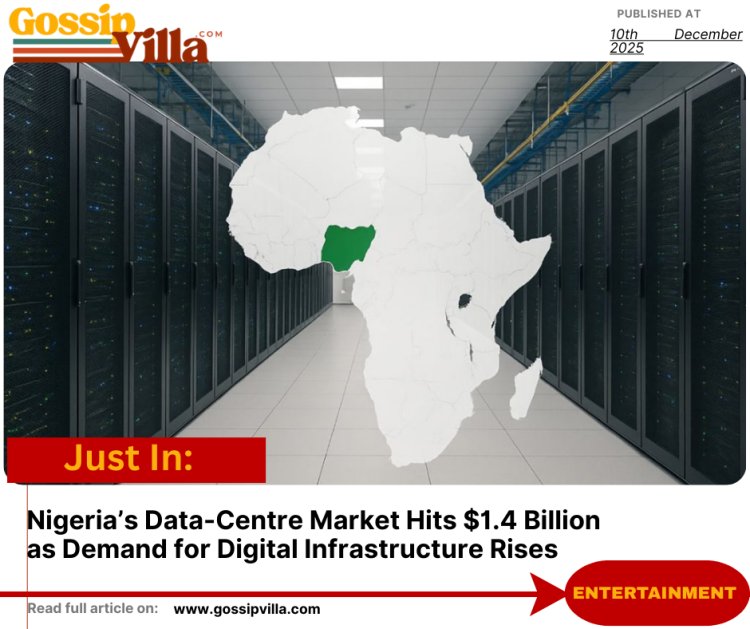
Nigeria’s Data-Centre Market Hits $1.4 Billion as Demand for Digital Infrastructure Rises
Nigeria’s data-centre market surges to $1.4 billion, driven by growing demand for digital infrastructure. Discover the trends shaping Nigeria’s tech landscape.

Nigeria’s digital economy is expanding rapidly, and one of the strongest indicators of this growth is the rise of the country’s data-centre market. In the last few years, Nigeria has moved from being a developing digital hub to becoming one of Africa’s most important data-infrastructure destinations. With more online activity, more businesses relying on cloud services, and more Nigerians embracing digital services for education, finance, communication, and commerce, the need for strong, reliable data-centre capacity has never been more important. Today, the value of Nigeria’s data-centre sector stands at an impressive $1.4 billion, and it is projected to almost double to $2.7 billion by 2035. This projection shows a strong future for the country’s digital infrastructure and highlights the opportunities that lie ahead for investors, businesses, and consumers. According to Nairametrics, this growth reflects increasing demand across several sectors of the economy.
A data centre is a critical part of the digital world. It is where digital information is stored, processed, and secured. Everything from mobile banking to government records, social media, video streaming, e-commerce, health technology, educational platforms, cloud computing, and even simple mobile apps all rely on data centres. When data centres are not strong enough or easily accessible, online services suffer. That is why Nigeria’s growing investment in this sector is important not only for big companies but for everyday users who depend on digital services.
One of the major reasons for the rapid rise in the value of Nigeria’s data-centre market is the increasing demand for cloud services. More Nigerian businesses are moving their operations online. Small businesses, fintech companies, media houses, retail stores, and even traditional companies now rely heavily on online data storage, cloud hosting, and digital platforms to operate. As these businesses continue to expand, they create a stronger need for data centres that can support heavy digital traffic. This shift also reduces the reliance on foreign data hosting, which has long affected performance and contributed to slower service speeds. According to the GlobeNewswire (Nigeria Data Centre Market Investment Report), more companies are choosing to keep their data in Nigeria to improve efficiency and meet compliance requirements.
Another major factor driving growth is the rise of digital services across the country. Nigeria now has over 150 million internet users, and this number continues to grow every year. More people are using smartphones, more people are streaming videos, more students are learning online, and more workers and companies are adopting remote work tools. All these activities require strong data-infrastructure support. As demand increases, data-centre companies are investing heavily in expanding capacity to keep up with usage trends. This is helping to push the overall market value to new heights.
The involvement of international and local technology giants also plays a major role in boosting confidence in the sector. Some of the world’s leading data-centre operators and cloud companies have already entered Nigeria, and more are planning to join. Local firms are equally expanding, building new facilities that meet global standards and offer top-tier services. This level of activity sends a positive signal to investors, showing that Nigeria has become a strategic digital hub in Africa. It also strengthens the trust of businesses that want to store and process their data within the country.
Infrastructure improvements across the country are contributing to this growth as well. Over the next decade, Nigeria’s data-centre capacity is expected to expand significantly. New facilities are being built with modern cooling systems, energy-efficient designs, advanced security systems, and cloud-ready architecture. These upgrades are key to meeting global standards and ensuring reliability. As more companies adopt digital tools, the pressure on data-centre operators increases, making expansion not just an option but a necessity.
The projected growth from $1.4 billion to $2.7 billion by 2035 also signals strong economic potential. A growing data-centre sector attracts technology companies, digital service providers, cloud platforms, and international investors. It also creates new job opportunities in technology, engineering, cybersecurity, customer support, and facility management. With Nigeria pushing to expand its digital economy, data centres form the backbone of future development. They are the silent engines that power apps, websites, digital payments, online schools, and countless services Nigerians use daily.
Another outcome of a strong data-centre ecosystem is reduced latency. Latency is the delay users experience when accessing online services. When data is hosted outside Nigeria, users often experience slower speeds. With more local hosting, services become faster, smoother, and more reliable. This makes a big difference in areas like fintech, streaming, e-commerce, and online education where speed is essential. Nigeria’s growing data-centre capacity ensures better user experiences and reduces the digital gap between Nigeria and more developed countries.
The benefits of this growth extend beyond big cities. As digital infrastructure expands, more communities gain access to strong online services, even in semi-urban or rural areas. This supports financial inclusion, digital literacy, remote learning, and access to government services. A strong data-centre sector means more people can participate in the digital economy, creating opportunities for small businesses and individuals across the country.
READ MORE ON HOW Poverty Surge in Nigeria Hits 139 Million Despite Tinubu’s Reforms ~World Bank
Looking ahead, Nigeria’s data-centre market shows strong potential to become one of the biggest in Africa. With rising internet penetration, increased digital adoption, growing smartphone usage, and continuous investments from major tech players, the country is ready for a more connected and digitally driven future. The projection of $2.7 billion by 2035 is not just a number; it is a reflection of Nigeria’s digital ambition and its growing influence in the African tech landscape.
As Nigeria continues to strengthen its digital infrastructure, data centres will remain at the heart of progress. They will support innovation, drive business growth, boost economic activity, and empower millions of Nigerians to participate in the digital world. The sector’s growth is a clear sign that Nigeria is moving forward and preparing for a future where digital services play an even bigger role in everyday life.
What's Your Reaction?