ANDROID INTRODUCES LIVE VIDEO FOR EMERGENCIES
Android introduces Emergency Live Video, a new safety feature that lets users share real-time video with emergency services to improve response speed and accuracy. Secure, private, and designed to save lives.
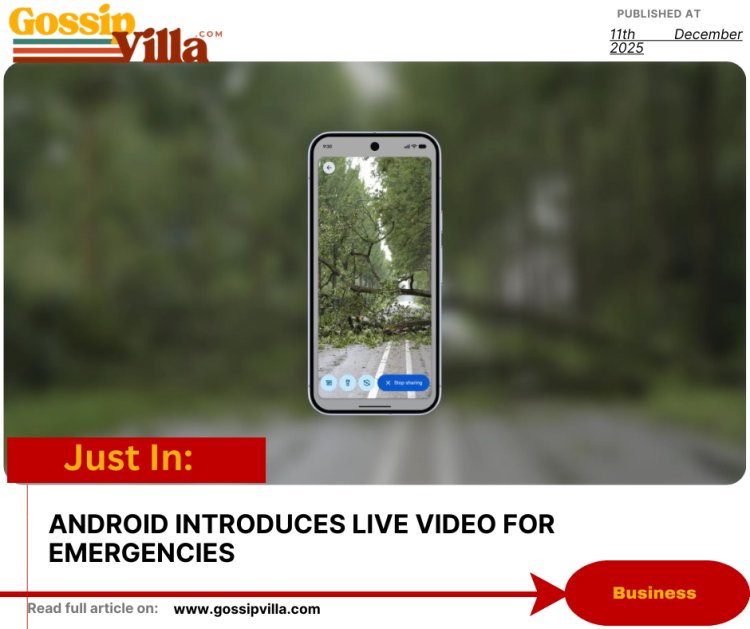
Google has added a major new safety feature to Android phones called Emergency Live Video. This feature allows users to share real-time video with emergency responders during accidents, medical issues, fires, or any dangerous situation. It is designed to help responders understand what is happening immediately so they can send the right help quickly. According to Google, this builds on Android’s existing safety tools like Emergency Location Sharing and crash detection, giving dispatchers the ability to see the situation instead of relying only on voice descriptions.
HOW THE FEATURE WORKS
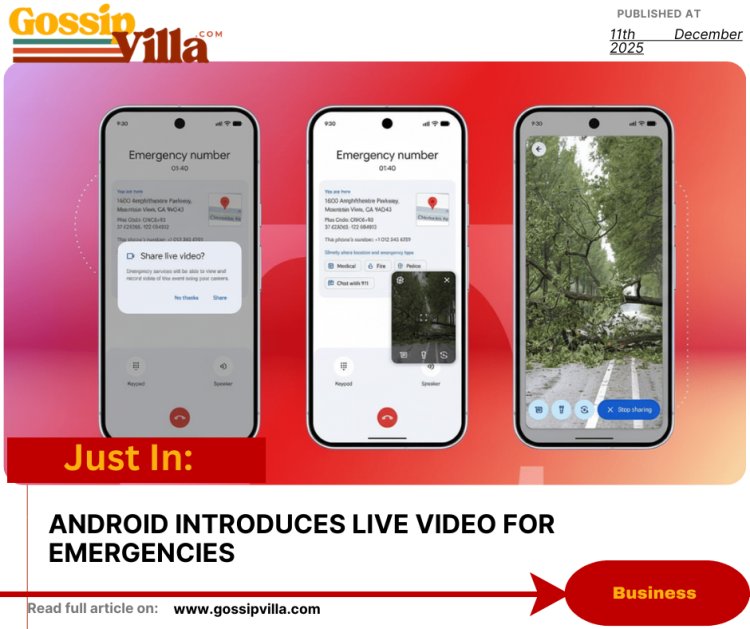
When someone calls emergency services, the dispatcher can request permission to access live video from the caller’s phone. The caller will see a prompt asking if they want to share video. If they accept, the phone starts streaming live footage directly to the emergency center.
The process is simple:
Video only starts after the caller taps “Allow.”
It is not saved or recorded by emergency centers.
It is encrypted for security.
The caller can stop the video at any time.
No extra app is required.
Because it is built directly into Android, anyone with a compatible device can use it when the feature becomes available in their region.
WHY THIS FEATURE IS IMPORTANT
In many emergencies, words alone cannot describe the situation properly. People may panic, struggle to speak, or fail to explain the scene clearly. Live video solves this by allowing responders to visually understand what is happening. According to TechCrunch, this feature allows dispatchers to make faster decisions, provide clear guidance, and ultimately save more lives.
Here’s why this matters:
Faster decision-making: Responders can immediately decide whether to send police, ambulance, or fire service.
Better assessment: They can see injuries, fire intensity, or dangerous environments.
Accurate guidance: They can guide the caller step-by-step based on what they see.
More lives saved: Response time improves when dispatchers have accurate information instantly.
For cities like Lagos, Abuja, Port Harcourt, and other crowded areas, this can make a real difference.
WHERE IT’S AVAILABLE
The feature is rolling out in phases. It will appear first in regions where emergency response centers have upgraded their systems to accept video. Android says the setup is simple for governments because it only requires software support.
Once local agencies in Africa and Nigeria adopt the system, millions of Android users will instantly gain access to the feature.
PRIVACY AND SECURITY
Google has emphasized that the feature is built with privacy in mind:
Emergency teams cannot turn on video without user permission.
Streams are encrypted from end to end.
The video cannot be saved, downloaded, or stored.
The caller remains fully in control at all times.
This ensures the feature is only used during real emergencies and only when the caller agrees.
BENEFITS FOR NIGERIA AND AFRICA
Nigeria relies heavily on Android phones, especially for everyday communication. Introducing live video could transform emergency response by giving dispatchers real-time visibility. Possible benefits include:
Faster response during road accidents
Better guidance during fire outbreaks
Clearer assessment in medical emergencies
Improved coordination during public safety issues
Visual confirmation during violent or chaotic events
As adoption grows globally, African emergency centers will likely follow.
READ MORE ON HOW Meta Buys Limitless: What This Big Move Says About the Future of AI Wearables
INDUSTRY REACTION
Tech analysts have praised this update as one of the most practical safety features Android has added in years. Instead of focusing only on entertainment or AI, this update focuses on saving lives. Experts say the feature could push other smartphone brands to introduce similar tools, eventually making live video a global emergency standard.
What's Your Reaction?