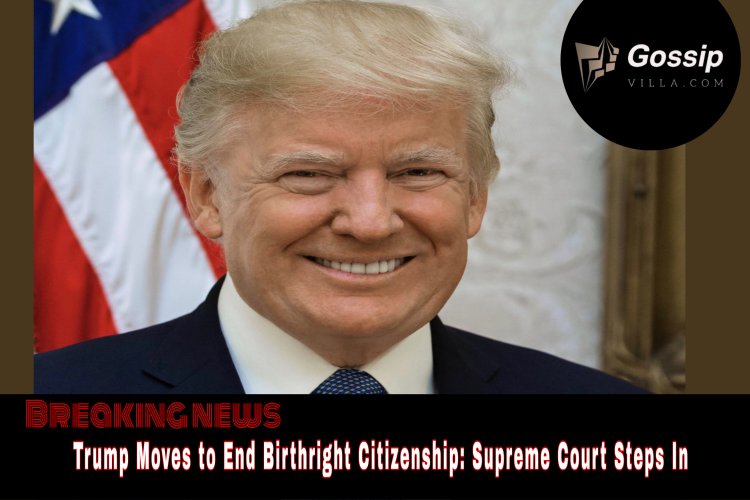
Trump Moves to End Birthright Citizenship: Supreme Court Steps In
U.S. Supreme Court to rule on Trump’s order ending birthright citizenship for children of non-citizens. A historic case that could reshape the American Dream and affect millions of immigrant families worldwide, including Nigerians in the diaspora.
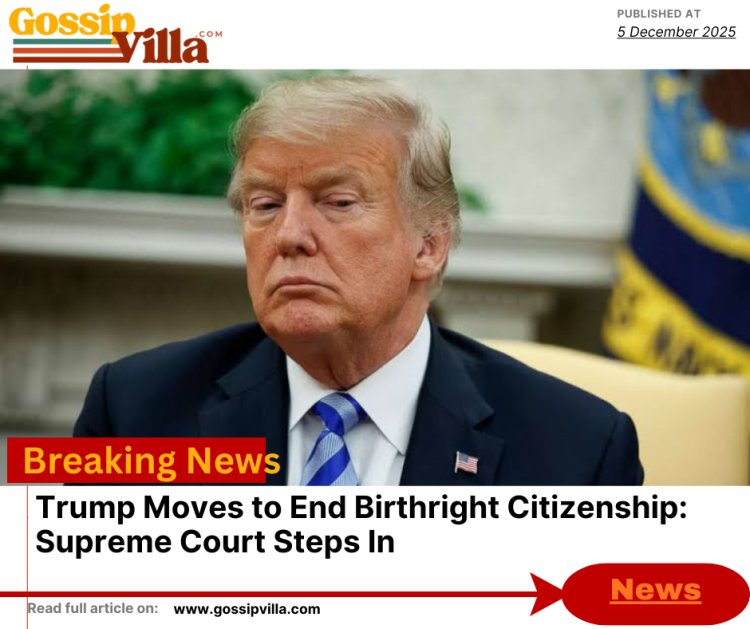
Trump Moves to End Birthright Citizenship: Supreme Court Steps In
A Landmark Clash Over Citizenship and the Constitution
In a decision that has sent shockwaves through the legal, political, and immigrant communities, the U.S. Supreme Court announced on Friday that it will hear arguments in a high-stakes challenge to President Donald Trump’s executive order seeking to dismantle birthright citizenship. Issued on his first day back in the White House on January 20, 2025, the order represents one of the most aggressive moves in Trump’s second-term immigration agenda. It directs federal agencies to deny automatic citizenship to children born on U.S. soil if neither parent is a citizen or lawful permanent resident. This policy, if upheld, could fundamentally alter the fabric of American identity, affecting hundreds of thousands of newborns each year and reopening a constitutional debate dormant for over a century.
The Court’s one-page order, released without dissent among the justices, signals that oral arguments will likely occur in early 2026, with a ruling expected by the end of the term in June. Coming just months after Trump’s inauguration, this case stemming from a class-action lawsuit filed in New Hampshire federal court marks the first time the Supreme Court will directly confront the merits of the president’s birthright citizenship curbs. Lower courts, including the district judge in Barbara v. Trump, have uniformly blocked the order as unconstitutional, citing violations of the 14th Amendment and longstanding federal statutes. Now, with a 6-3 conservative majority that includes three Trump appointees, the justices face a test of their independence from the executive branch they helped empower. (Reuters)
The Roots of Birthright Citizenship: A Post-Civil War Promise
To understand the gravity of this case, one must trace birthright citizenship back to the ashes of the Civil War. Ratified in 1868 as part of the 14th Amendment, the Citizenship Clause declares: “All persons born or naturalized in the United States, and subject to the jurisdiction thereof, are citizens of the United States and of the State wherein they reside.” This provision was no abstract legalism; it was a deliberate rebuke to the Supreme Court’s infamous 1857 Dred Scott v. Sandford decision, which denied citizenship to Black Americans, whether enslaved or free.
According to Whitehouse, The framers of the 14th Amendment intended to ensure that citizenship extended to the children of freed slaves, born on American soil. But its language was broad, encompassing “all persons” without qualifiers based on parental status. In 1898, the Supreme Court solidified this interpretation in United States v. Wong Kim Ark, a landmark ruling involving the son of Chinese immigrants. The Court held that “subject to the jurisdiction thereof” excludes only children of foreign diplomats or invading armies not those born to undocumented or temporary residents. Wong Kim Ark, denied re-entry to the U.S. after a trip abroad, was affirmed as a citizen by birth, establishing a precedent that has guided immigration law for 127 years.
Congress reinforced this understanding in the Immigration and Nationality Act of 1952, which codified birthright citizenship and explicitly rejected narrower readings. Today, the U.S. joins about 30 nations, including Canada and Mexico, in granting jus soli (right of soil) citizenship. It’s a cornerstone of American exceptionalism, symbolizing a nation unbound by bloodlines, where opportunity is not inherited but claimed by birth on free ground.
Trump’s Order: A Bold Executive Gambit
President Trump’s executive order, titled “Protecting the Meaning and Value of American Citizenship,” arrives amid his renewed crusade against what he calls “birth tourism” and “anchor babies.” During his 2024 campaign, Trump vowed to end birthright citizenship on day one, framing it as a loophole exploited by undocumented immigrants to secure family footholds in the U.S. The order instructs agencies like the State Department and U.S. Citizenship and Immigration Services to interpret the 14th Amendment’s “jurisdiction” clause as requiring parental “primary allegiance” to the United States—defined as citizenship or permanent residency with intent to remain indefinitely.
Under this framework, children born to undocumented parents, tourists, or holders of temporary visas (like H-1B workers) would be ineligible for passports, Social Security numbers, or other citizenship proofs. The administration argues this aligns with the amendment’s original intent, citing historical debates where some senators expressed concerns about “gypsies” or Native Americans. It also invokes national security, claiming automatic citizenship incentivizes illegal border crossings.
Critics, including the American Civil Liberties Union (ACLU), which spearheaded the New Hampshire lawsuit, decry the order as a humanitarian catastrophe. The suit, filed by two affected infants, their parents, and a pregnant woman on behalf of a nationwide class, warns of “effectively stateless” children denied citizenship in their birth country and unlikely to receive it from parents’ nations of origin. Immigration advocates like FWD.us have called it “unlawful and unconstitutional,” arguing it would sow confusion in hospitals, schools, and communities, discriminating against Latino, Asian, and African families disproportionately.
The policy’s rollout has been chaotic. Hospitals in border states report hesitancy among expectant mothers to seek prenatal care, fearing documentation scrutiny. Legal scholars note that implementation would require rewriting birth certificate protocols and could retroactively question the status of millions, though the administration insists it applies prospectively.
The Legal Battle: From Lower Courts to the High Court
The order’s legal odyssey began swiftly. Within weeks of issuance, federal judges in California, Texas, and New Hampshire issued preliminary injunctions, halting enforcement. These nationwide blocks prompted the Trump administration to appeal to the Supreme Court last spring, not on the policy’s merits but on the propriety of “universal injunctions” by single district judges. In a 6-3 decision penned by Justice Amy Coney Barrett, the Court curtailed such broad remedies, ruling they exceeded judicial authority. However, it greenlit class-action certifications as an alternative path for sweeping relief—a door the ACLU promptly walked through.
The New Hampshire case, certified as a class action in September, returned to the district court, where Judge Jane Barbara again enjoined the order, declaring it “flatly contradicts Wong Kim Ark and the plain text of the 14th Amendment.” The 1st U.S. Circuit Court of Appeals affirmed, prompting the Justice Department’s certiorari petition. In its brief, the administration urged the Court to “reexamine” birthright citizenship in light of modern immigration pressures, arguing that executive interpretation of constitutional ambiguities is entitled to deference under cases like Chevron U.S.A. Inc. v. Natural Resources Defense Council (though Chevron was overturned in 2024, the government pivots to historical practice).
Challengers counter that the president lacks unilateral power to redefine constitutional text, a role reserved for Congress or the courts. They highlight that even originalists like Justice Antonin Scalia affirmed Wong Kim Ark‘s holding in later opinions. Amicus briefs from historians, the U.S. Conference of Catholic Bishops, and tech giants (citing H-1B families) underscore the order’s overreach.
Broader Implications: Redefining American Identity
If the Supreme Court upholds the order, the ripple effects would be profound. Annually, about 300,000 children are born to undocumented parents, per Pew Research estimates many now facing limbo. Schools could deny enrollment, hospitals billing disputes, and deportation proceedings could ensnare U.S.-born minors as leverage against parents. Economically, it might deter skilled immigrants, hampering industries like tech and agriculture. Globally, it would isolate the U.S., aligning it more with restrictive jus sanguinis (right of blood) systems in Europe.
Politically, the case galvanizes Trump’s base, fulfilling a 2018 promise thwarted by his first-term legal woes. Yet it risks alienating moderates; polls show 60% of Americans support birthright citizenship, per a 2025 Gallup survey. Democrats, led by Senate Minority Leader Chuck Schumer, have vowed legislation to codify it further, though Republican control of Congress dims prospects.
For immigrant communities, the stakes are existential. Stories abound of families in limbo: a Salvadoran mother in Los Angeles, unable to secure daycare for her infant daughter; a Indian engineer in Silicon Valley, weighing relocation abroad. Advocacy groups warn of increased child poverty and family separations, echoing the traumas of Trump’s prior policies.
Read more on: U.S. Lawmakers Advocate Sanctions Against Miyetti Allah Over Alleged Religious Freedom Violations
What Lies Ahead: A Court at the Crossroads
As the justices prepare to delve into this fray, observers are divided. The conservative bloc Chief Justice John Roberts, Justices Clarence Thomas, Samuel Alito, Neil Gorsuch, Brett Kavanaugh, and Barrett has favored executive immigration authority in cases like Biden v. Texas (2022). Yet birthright citizenship implicates core constitutional values, potentially prompting Roberts to seek a narrow ruling preserving Wong Kim Ark while allowing limited executive tweaks.
Liberal justices Sonia Sotomayor, Elena Kagan, and Ketanji Brown Jackson are expected to dissent vigorously, viewing the order as discriminatory. A 5-4 split, with Roberts or Kavanaugh as swing votes, seems plausible. Whatever the outcome, this case will etch itself into history, deciding not just policy but the soul of the American Dream: Is citizenship a birthright for all on these shores, or a privilege tethered to parental papers?
In the words of the ACLU’s brief, birthright citizenship “represents the promise that their children can achieve their full potential as Americans.” As arguments unfold, the nation watches, wondering if that promise endures.
What's Your Reaction?