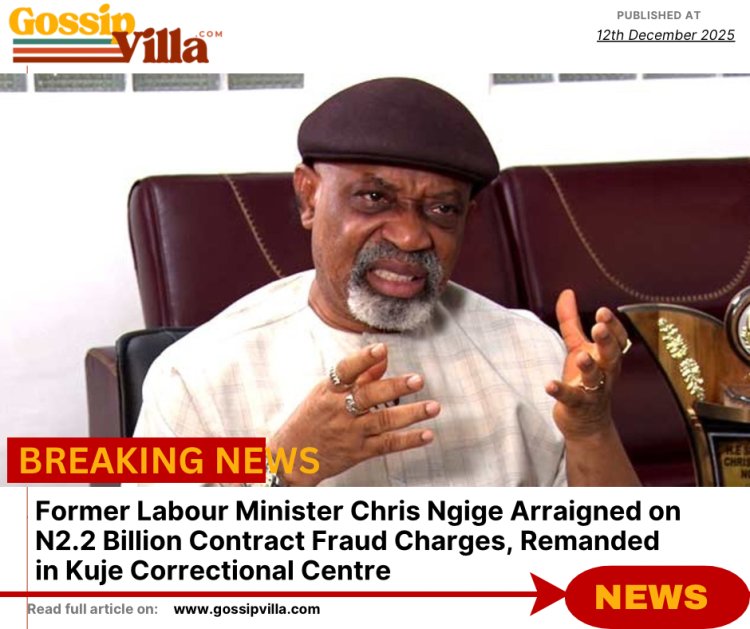
Former Labour Minister Chris Ngige Arraigned on N2.2 Billion Contract Fraud Charges, Remanded in Kuje Correctional Centre
Former Minister of Labour and Employment, Dr. Chris Ngige, has been arraigned by the EFCC on eight counts of N2.2 billion contract fraud and remanded in Kuje Correctional Centre pending bail hearing. The charges border on abuse of office and corrupt enrichment through NSITF contracts awarded to companies linked to his associates.
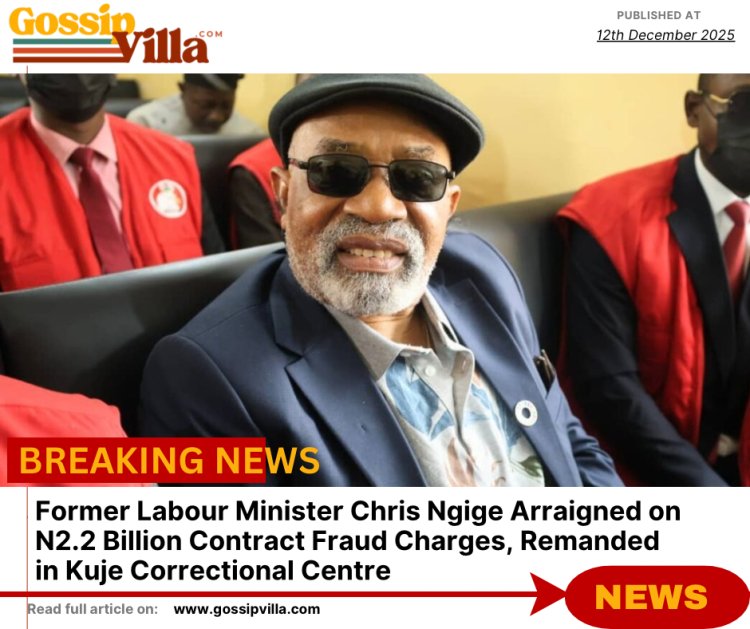
Former Labour Minister Chris Ngige Arraigned on N2.2 Billion Contract Fraud Charges, Remanded in Kuje Correctional Centre
In a development that has sent shockwaves through Nigeria’s political landscape, Dr. Chris Nwabueze Ngige, former Minister of Labour and Employment, was arraigned before the Federal Capital Territory High Court in Gwarinpa, Abuja, on Friday, December 12, 2025. The Economic and Financial Crimes Commission (EFCC) brought an eight-count charge against the erstwhile Anambra State governor, alleging contract fraud, abuse of office, and corrupt enrichment totaling N2.2 billion. Ngige, aged 73, pleaded not guilty to all counts. However, Justice Maryam Aliyu Hassan rejected an oral bail application from his defense team and ordered his remand at the Kuje Correctional Centre pending a formal bail hearing scheduled for Monday, December 15, 2025.
This dramatic turn of events underscores the intensifying anti-corruption crusade under President Bola Tinubu’s administration, targeting high-profile figures from the preceding Muhammadu Buhari era. Ngige’s detention in Kuje, a facility notorious for its harsh conditions and housing of prominent detainees marks a stark contrast to his decades-long career as a resilient political operator. As the nation reflects on this case, it raises critical questions about accountability, selective justice, and the integrity of public institutions like the Nigeria Social Insurance Trust Fund (NSITF), over which Ngige presided as supervising minister from 2015 to 2023.
A Storied Political Trajectory: From Resilience to Reckoning
Chris Ngige’s ascent in Nigerian politics is the stuff of legend, fraught with intrigue, defiance, and unyielding ambition. Born on April 23, 1952, in Alor, Anambra State, Ngige pursued a medical degree at the University of Nigeria, Nsukka, before entering public service as a consultant physician. His political baptism came in 2003, when, as the All Progressives Grand Alliance (APGA) candidate, he clinched the Anambra governorship amid allegations of electoral malfeasance and violence. His tenure, spanning 2003 to 2006, was defined by aggressive infrastructure development, including the rehabilitation of over 500 kilometers of roads, and security enhancements that curbed rampant kidnappings. Yet, it was overshadowed by a high-profile abduction scandal allegedly masterminded by his political mentor, Chris Uba, which Ngige survived and parlayed into a narrative of indomitable spirit.
Ousted by a court ruling in 2006, Ngige pivoted seamlessly to the opposition, joining the Action Congress (AC) and later the All Progressives Congress (APC). He secured a Senate seat for Anambra Central in 2011, where he championed labor rights and federalism. His national prominence surged in 2015 with his appointment as Minister of Labour and Employment under Buhari. Over eight tumultuous years, Ngige navigated contentious labor disputes, including the 2018 minimum wage negotiations and repeated strikes by the Nigeria Labour Congress (NLC). He also oversaw reforms at the NSITF, an agency established under the 1993 Employee’s Compensation Act to manage social insurance for workers, handling billions in employer contributions for pensions and injury compensation. (Punch News)
Ngige’s ministerial exit in May 2023 followed the APC’s presidential primaries, where he mounted a spirited but unsuccessful challenge against Tinubu. Post-tenure, he maintained influence within the APC’s Southeast caucus, advocating for equitable power rotation. Whispers of irregularities at NSITF such as over-invoiced contracts and procurement breaches had surfaced during his watch, notably in a 2019 House of Representatives probe that flagged N17 billion in dubious expenditures. However, it was the EFCC’s renewed vigor post-2023 that propelled these into a full-blown prosecution, with Ngige arrested in a commando-style operation on Wednesday, December 10, 2025.
Unpacking the Charges: A Pattern of Alleged Cronyism
The EFCC’s charge sheet, filed under case number FCT/HC/CR/726/2025, meticulously details a web of favoritism and gratification spanning September 2015 to May 2023. Prosecutors, led by Senior Advocate of Nigeria (SAN) Sylvanus Tahir, accuse Ngige of leveraging his supervisory role at NSITF to award inflated contracts to entities linked to his associates, contravening Sections 17(a) and 19 of the Corrupt Practices and Other Related Offences Act, 2000. Each count carries a minimum five-year imprisonment upon conviction.
Central to the allegations are three companies purportedly serving as Ngige’s conduits for illicit gains:
• Cezimo Nigeria Limited: Owned by Ezebinwa Amarachukwu Charles, described as Ngige’s “associate and alter ego.” The firm allegedly secured seven contracts for consultancy, training, and supplies worth N366,470,920.68, followed by eight more totaling N583,682,686. Additionally, a N38.65 million “gift” was funneled to Ngige’s Chris Nwabueze Ngige Campaign Organisation via a Zenith Bank account.
• Jeff & Xris Limited: Controlled by Nwosu Jideofor Chukwunwike, another alleged confidant. This entity purportedly received eight contracts valued at N362,043,163.16, alongside a N26 million gratification.
• Zitacom Limited: Linked to similar networks, it allegedly benefited from contracts amounting to N55 million, including direct bribes.
The EFCC contends these awards bypassed due procurement processes, inflating costs for taxpayer-funded worker protections. Tahir emphasized during proceedings that the offenses erode public trust and warrant stringent measures, including remand to prevent tampering or flight. He highlighted Ngige’s failure to surrender his international passport post a medical trip in October 2025, a stipulation of prior administrative bail.
Courtroom Tensions: Pleas, Protests, and Procedural Stalemate
According to AIT LIVE, The arraignment unfolded with procedural intensity at Courtroom 5 of the Gwarinpa High Court. Ngige, attired in a dark suit and flanked by EFCC operatives, arrived shortly after 8 a.m. amid a throng of journalists and supporters. As charges were intoned, the septuagenarian listened impassively, entering a firm not-guilty plea. His lead counsel, Patrick Ikwueto (SAN), swiftly moved for bail, citing short notice of the arraignment only Thursday evening and Ngige’s health vulnerabilities, including recent hospitalizations.
“I can afford any bail condition; let me go home. I have health challenges,” Ikwueto quoted Ngige as imploring, underscoring three days already spent in EFCC custody. The defense disputed the passport issue, claiming it was stolen and duly reported to the EFCC via letter a claim Tahir contested, insisting on ignorance thereof. Ikwueto further argued the charges’ non-capital nature precluded automatic remand, likening them to bailable economic offenses.
Tahir countered vehemently, decrying the oral application as irregular and urging remand at Kuje to safeguard the trial’s integrity. “These are grave felonies with mandatory custodial sentences,” he submitted, warning of Ngige’s potential to influence witnesses. Justice Hassan, balancing equities, deferred the written bail application to December 15, ruling: “The court cannot entertain an oral plea at this juncture.” She fixed trial dates for February 2026, ordering Ngige’s transfer to Kuje, where he will endure the weekend’s austere confines.
Broader Implications: Selective Justice in the Anti-Corruption Arena?
Ngige’s predicament ignites debates on the EFCC’s impartiality. Social media, erupted with #NgigeInKuje trending, amassing over 50,000 mentions by evening. Critics decry “political vendetta,” noting Ngige’s recent overtures to opposition figure Peter Obi for a potential 2027 alliance, just days before his arrest.
Supporters within the APC, including Anambra Senator Ifeanyi Ubah, urge presumption of innocence, while NLC spokespersons demand probes into NSITF’s worker impacts. Economically, the alleged N2.2 billion diversion amid 34% unemployment and naira volatility could have funded vocational programs for thousands, per analysts. This case parallels recent indictments of ex-Aviation Minister Stella Oduah and others, signaling Tinubu’s EFCC offensive but fueling accusations of “Buhari-era recycling.”
Kuje’s notoriety amplifies the human element: Overcrowded cells, erratic power, and medical inadequacies pose risks for Ngige’s age and ailments. Legal pundits forecast a protracted battle, with appeals potentially extending to 2027, akin to Orji Kalu’s odyssey.
READ MORE ON : Court Orders Final Forfeiture of ₦11.2 Billion Linked to Businesswoman Aisha Achimugu
Toward Resolution: Bail Prospects and Systemic Reforms
Monday’s hearing looms pivotal. A granted bail may impose sureties from APC stalwarts, asset forfeiture, and passport impoundment. Denial could galvanize Ngige’s base, fracturing Southeast APC cohesion. His defense strategy will likely assail evidentiary gaps, procedural lapses, and contextualize contracts as legitimate oversight.
Beyond Ngige, this saga spotlights NSITF’s chronic vulnerabilities: Ghost beneficiaries, elite capture, and weak audits. Reforms digital procurement, whistleblower safeguards are imperative for fiscal hygiene. As Tinubu’s “Renewed Hope” pivots to accountability, cases like this test resolve against cronyism.
Ngige’s journey, from kidnapped governor to ministerial titan, now prison inmate epitomizes Nigeria’s paradoxes. “I will not be intimidated,” he once declared in 2003. From Kuje’s shadows, that defiance endures, awaiting judicial vindication or verdict. The nation holds its breath: Justice served, or power play unveiled?
What's Your Reaction?