Tinubu Reaffirms Withdrawal of Police from VIPs Amid Exposure Concerns
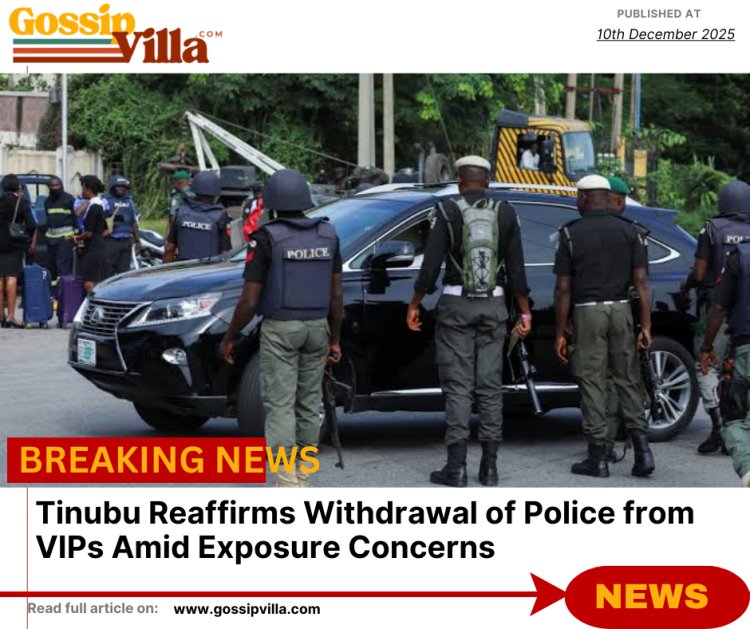
President Tinubu doubles down: all police escorts attached to politicians, ex-governors & big men withdrawn immediately to fight kidnapping & banditry. VIPs must now use NSCDC or private security.
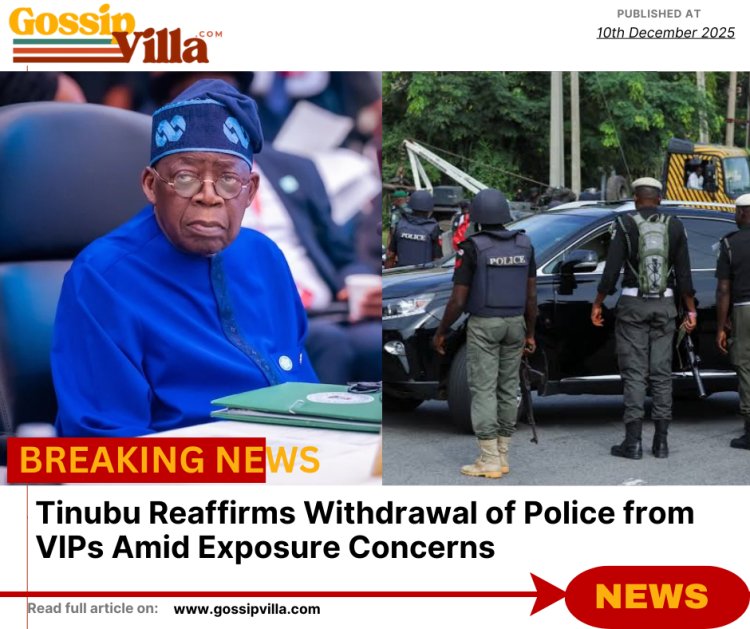
Tinubu Reaffirms Withdrawal of Police from VIPs Amid Exposure Concerns
A Bold Step for Nigeria’s Security Overhaul
In a nation grappling with escalating threats of kidnapping, banditry, and insurgency, President Bola Ahmed Tinubu has once again thrown down the gauntlet on a contentious security reform. On Wednesday, during a high-stakes Federal Executive Council (FEC) meeting at the State House in Abuja, Tinubu reaffirmed his directive for the immediate withdrawal of thousands of police officers currently assigned as escorts to Very Important Persons (VIPs) across Nigeria. This move, first announced in late November, aims to redeploy these personnel to frontline operations, bolstering the fight against rampant insecurity. Yet, as the policy gains renewed momentum, concerns over the “exposure” of VIPs politicians, business moguls, and high-profile figures have sparked heated debates. Is this a necessary recalibration of resources, or a risky gamble that could leave the elite vulnerable?
The reaffirmation comes at a pivotal moment. Reports indicate partial non-compliance from some quarters, with lingering police details still shadowing VIPs despite the initial order.
Tinubu’s insistence underscores a no-nonsense approach: Nigeria’s security architecture must prioritize the masses over the privileged few. “We are facing challenges of kidnapping. We need all the forces we have on the ground, fully utilised,” the President declared, framing the decision as a direct response to a surge in abductions plaguing northern states and beyond. With an estimated 100,000 officers tied up in VIP protection duties, a staggering figure that diverts nearly a third of the Nigeria Police Force (NPF) from core responsibilities—this redeployment could inject vital manpower into counter-insurgency efforts, community patrols, and highway security.
The Genesis of the Directive: From Crisis to Command
To understand the urgency behind Tinubu’s reaffirmation, one must rewind to November 24, 2025. During an emergency security parley with service chiefs, Inspector General of Police (IGP) Kayode Egbetokun, and the Director-General of the Department of State Services (DSS), the President issued the original order. This was no knee-jerk reaction but a calculated strike against systemic inefficiencies exposed by a wave of mass abductions.
Punch news highlighted that “In Kwara and Kebbi states alone, hundreds of schoolchildren and travelers were snatched in coordinated raids, prompting Tinubu to cancel a scheduled trip to the G20 Summit in South Africa to oversee rescue operations personally”.
Nigeria’s security landscape has long been strained. The NPF, with approximately 400,000 officers for a population exceeding 220 million, operates at a ratio of one officer per 550 citizens far below the UN-recommended 1:220 benchmark. VIP protection, a colonial-era relic amplified by political patronage, has exacerbated this shortfall. Politicians, governors, and even minor functionaries often command entourages of 10 to 50 officers, turning public servants into private bodyguards. This not only inflates the federal budget estimated at billions of naira annually but also fosters corruption, with “escort fees” becoming an open secret in police barracks.
Tinubu’s administration, inheriting these challenges from previous regimes, has positioned this reform as a cornerstone of its “Renewed Hope” agenda. By pulling officers from VIP duties, the government seeks to restore public confidence, enhance response times in high-risk areas, and redirect funds toward equipping frontline units.
Early indicators are promising: In Lagos, a monitoring team from the NPF has already begun enforcement, ensuring compliance in key hotspots. Yet, the path to full implementation is fraught with resistance, particularly from those who fear the policy’s unintended consequences.
Navigating the Exposure Concerns: Balancing Elite Security and National Imperative
The elephant in the room and the crux of the “exposure concerns” is the potential vulnerability of VIPs post-withdrawal. High-profile figures, from senators to corporate titans, have voiced apprehensions that stripping away dedicated police escorts could invite targeted attacks, especially amid rising kidnapping-for-ransom schemes. “We cannot afford to leave our people exposed,” Tinubu himself acknowledged during the FEC meeting, signaling a pragmatic pivot to mitigate backlash.
In a bid to address these fears, the President issued complementary directives. He tasked the Minister of Interior, Olubunmi Tunji-Ojo, to collaborate with IGP Egbetokun and the Nigeria Security and Civil Defence Corps (NSCDC) for seamless replacements. Where police are withdrawn, NSCDC officers equally armed and trained will step in for VIP protection, ensuring continuity without compromising the redeployment goals. For exceptional cases, such as ministers in conflict zones,
According to Premuim Times, Tinubu stipulated that requests for police reinstatement must go through the IGP with presidential clearance, preventing abuse.
Critics, however, argue this is a band-aid on a gaping wound. Opposition voices, including former lawmakers, have called for prosecuting “saboteurs” within the security apparatus who might undermine the process. Security experts echo these sentiments, warning that NSCDC’s capacity historically focused on civil defense rather than elite protection may be stretched thin. “Replacing one overburdened force with another risks diluting effectiveness,” noted a retired DSS operative in a recent op-ed. Moreover, the policy’s equity is questioned: While everyday Nigerians endure daily perils without escorts, why should VIPs receive any special treatment at all?
Proponents counter that the directive promotes fairness and efficiency. By freeing up officers, the NPF can intensify patrols in schools, markets, and rural highways precisely where abductions thrive. Tinubu’s broader vision ties this to economic reforms, including a nationwide ranching initiative led by Vice President Kashim Shettima. Through the National Economic Council (NEC), the administration plans to convert grazing reserves into modern ranches, curbing herder-farmer clashes that fuel insecurity. Arming forest guards, as authorized by National Security Adviser Nuhu Ribadu, further fortifies rural defenses. These interconnected measures signal a holistic strategy: Secure the land to secure the people.
Implications for Nigeria’s Security Future: Challenges and Opportunities
As implementation ramps up, the ripple effects of Tinubu’s reaffirmation will test the resilience of Nigeria’s institutions. On the positive side, redeployed officers could tip the scales in ongoing operations against Boko Haram remnants and bandit syndicates in the Northwest. Enhanced community policing, a pillar of the directive, promises to bridge the trust gap between citizens and law enforcement, fostering intelligence-sharing that has long been hampered by understaffing.
Economically, the policy aligns with fiscal prudence. Diverting resources from VIP luxuries to public safety could yield dividends in agricultural productivity and tourism, sectors crippled by insecurity. The ranching push, for instance, addresses root causes like resource competition, potentially averting conflicts that displace millions annually.
Yet, challenges loom large. Logistical hurdles training NSCDC replacements, monitoring compliance nationwide, and quelling elite pushback demand swift action. Public perception is another wildcard; if high-profile incidents occur during the transition, it could erode support for the administration. Civil society groups are already mobilizing for transparency, urging audits of VIP allocations to expose patronage networks.
Internationally, Tinubu’s move garners quiet applause. Regional partners like Benin Republic, fresh from a foiled coup with Nigerian assistance, view it as a stabilizing force. It positions Nigeria as a proactive leader in West African security, potentially unlocking aid for capacity-building.
READ MORE ON : Nigeria Police Deploy Special Team to Enforce Ban on VIP Escorts
A Call for Collective Resolve
President Tinubu’s reaffirmation of the VIP police withdrawal is more than administrative housekeeping; it’s a clarion call for equity in a fractured nation. Amid exposure concerns, the directive reminds us that true security isn’t hoarded by the few but shared by the many. By addressing vulnerabilities through NSCDC integration and ancillary reforms, the government has laid a foundation for sustainable change. Success, however, hinges on unwavering enforcement and public buy-in.
As Nigeria navigates this turbulent chapter, citizens must hold leaders accountable while supporting frontline heroes.
The stakes are existential: A safer polity isn’t just aspirational, it’s imperative. In the words of Tinubu, “The policy must be implemented without exception.” Let this be the turning point where privilege yields to progress.
What's Your Reaction?