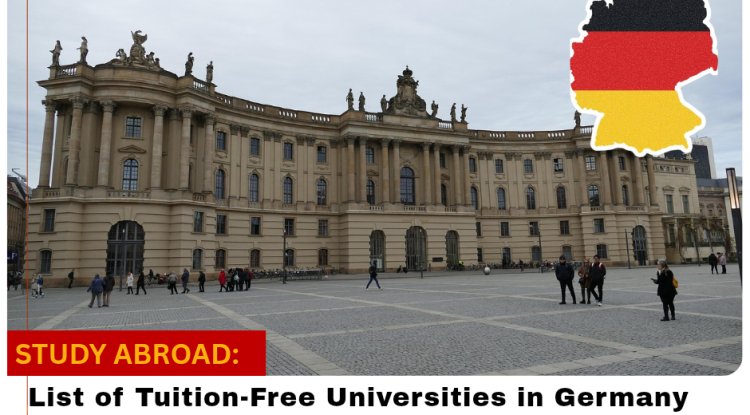
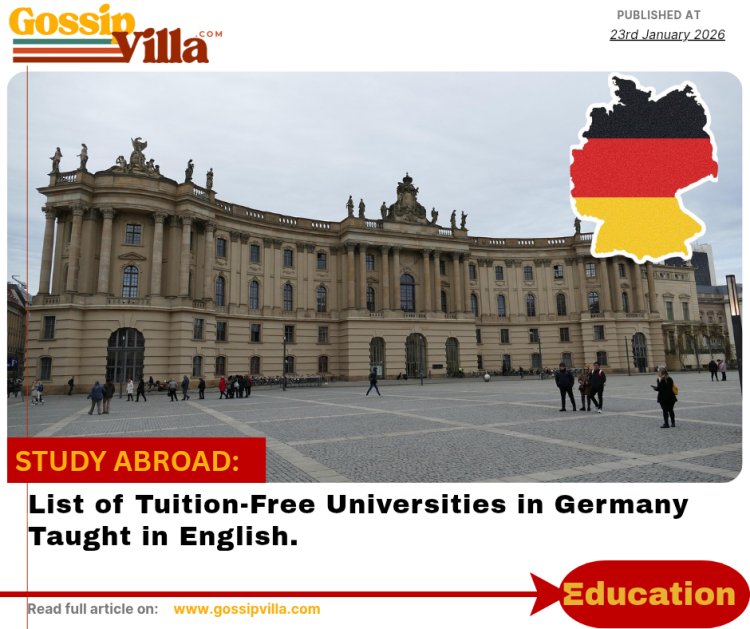
List of Tuition-Free Universities in Germany Taught in English.
Discover the top tuition-free universities in Germany for the 2026 intake. Our definitive guide covers English-taught programs, cost of living, blocked account requirements, and expert tips for international students to secure admission at world-class institutions like TUM and LMU without paying tuition.
The Ultimate Guide to Tuition-Free Universities in Germany Taught in English: 2026 Intake
You’ve likely heard the rumor: you can study at world-class universities in Germany for free. Then you looked at your bank account, saw the rising cost of living, and wondered if "free" is just a marketing gimmick for international students.
As a senior consultant who has spent over 15 years navigating the complexities of the Bologna Process and German university admissions, I can tell you the "free" dream is real but it has changed. During the 2026 intake, we noticed a sharp increase in competition for English-taught programs. If you don't have a clear roadmap, you will lose your spot to a candidate who does. This guide provides that roadmap.
What are the Best Tuition-Free Universities in Germany Taught in English?
The Short Answer: Most public universities in Germany offer tuition-free English-taught programs for international students. Top-tier institutions include Technical University of Munich (TUM), Ludwig Maximilian University (LMU), and RWTH Aachen. While tuition is $0, students must pay a "semester contribution" of €150–€400 and prove €11,940 in a blocked account for living expenses.
Why Germany Remains the Top Choice in 2026
In my experience helping students from over 50 countries, the draw of Germany isn't just the $0 price tag. It’s the industry-integrated learning. Unlike the theoretical heavy-lifting found in many US or UK institutions, German public universities are often physically connected to global giants like Siemens, BMW, and SAP.
For the 2026 academic year, Germany has expanded its English-taught offerings specifically in Data Science, Sustainability, and Robotics. We are seeing a 12% increase in programs that require zero German language proficiency for admission, making it more accessible than ever for non-native speakers.
What We Observed in 2026
What we noticed during the recent application cycles is that "Automatic Admission" is a myth. Even at free universities, the Numerus Clausus (NC) the grade point average requirement is becoming stricter. If your GPA is below a 3.0 (on a 4.0 scale), you’ll need to bolster your profile with internships or higher GRE/GMAT scores to remain competitive.
The 2026 Reality Check: Is it Truly "Free"?
Before we list the schools, we must address the "Baden-Württemberg and Bavaria" exceptions. While most of Germany is tuition-free, these two states have introduced fees for non-EU students.
- Baden-Württemberg: Expect to pay €1,500 per semester at universities like Heidelberg or Freiburg.
- Bavaria: Universities like TUM have recently introduced "discretionary fees" for specific programs ranging from €2,000 to €6,000.
- Semester Contribution: This is NOT tuition. It covers your student union fees and, most importantly, your Semesterticket (free public transit).
Expert Tip: Always check the specific program's "Fees" tab. We’ve seen students assume a Master’s at TUM is free, only to be hit with a €4,000 invoice because they chose a specialized "Executive" track.
Top 10 Tuition-Free Universities in Germany Taught in English
Here is our curated list of the best public universities where you can study in English without paying a dime in tuition fees.
1. Technical University of Munich (TUM)
Known as the "Harvard of Germany," TUM is a powerhouse for engineering and tech.
- Best For: Aerospace Engineering, Informatics, Management & Technology.
- English Programs: Over 100+ Master’s programs and a growing number of Bachelor’s.
- 2026 Update: Competition is at an all-time high. Apply as soon as the portal opens in January.
2. Ludwig Maximilian University of Munich (LMU)
If you are into research or humanities, LMU is your home.
- Best For: Data Science, Quantitative Economics, Physics.
- Note: Located in Munich, which has the highest cost of living in Germany. You’ll need to plan your financial aid early.
3. RWTH Aachen University
This is the go-to institution for Mechanical and Automotive Engineering.
- Best For: Engineering, Production Systems, Simulation Sciences.
- English Programs: Primarily at the Master's level.
- Cost Advantage: Aachen is significantly more affordable than Munich or Berlin.
4. Humboldt University of Berlin
A historic institution in the heart of the capital.
- Best For: Economics, Social Sciences, Mathematical Physics.
- Vibe: Very international. Berlin is a hub for startups, making it easy to find English-speaking part-time jobs.
5. University of Bonn
Consistently ranked among the top 100 universities globally.
- Best For: Immunobiology, Mathematics, Economics.
- Expert Insight: Their Mathematics department is world-renowned; admission is grueling but the degree carries immense weight.
6. Free University of Berlin (FU Berlin)
Specializes in social sciences and humanities.
- Best For: International Relations, North American Studies, Sociology.
- Language Requirement: While taught in English, they appreciate seeing a B1 level of German for your own social integration.
7. University of Hamburg
A great choice for those interested in law, climate science, or business.
- Best For: Integrated Climate System Sciences, Politics, International Business.
8. University of Freiburg
Located in the sunniest part of Germany.
- Best For: Environmental Sciences, Renewable Energy Engineering.
- Fee Alert: Remember, this is in Baden-Württemberg. Non-EU students pay €1,500 per semester.
9. University of Göttingen
Ideal for those pursuing degrees in natural sciences and biology.
- Best For: Molecular Biology, Agriculture, Neuroscience.
10. Rhine-Waal University of Applied Sciences
One of the few universities where almost all programs are taught in English.
- Best For: Sustainable Agriculture, Gender and Diversity, Mechatronics.
- Bachelor’s Focused: If you are looking for an English-taught Bachelor’s degree, this should be at the top of your list.
Costs Beyond Tuition: The 2026 Budget
While the university is free, the German government needs to know you won't starve. For the 2026 visa, the Blocked Account (Sperrkonto) requirement has risen.
Expense Category and Monthly Estimated Cost:
- Rent (Student Dorm/WG): €350 – €650
- Food & Groceries: €200 – €300
- Health Insurance: €110 – €130
- Semester Contribution: €30 (pro-rated)
- Leisure & Travel: €100
Total Monthly Budget | €790 – €1,210 |
Total Blocked Account Requirement for 2026: €11,940 per year.
Companies like Fintiba or Expatrio are the industry standard for setting these up quickly.
Funding Your Dreams: International Student Loans & Scholarships
Many students ask me, "If the tuition is free, why do I need a loan?" The answer is the blocked account. If you don't have €12,000 sitting in a bank, you’ll need to explore international student loans.
- Prodigy Finance / MPOWER: These lenders offer loans based on your future earning potential rather than your current collateral.
- HDFC Credila (For Indian Students): A popular choice for covering both the blocked account and travel expenses.
- DAAD Scholarships: The gold standard. If you have a high GPA, the DAAD Master’s Scholarship provides €934/month, essentially making your stay profitable.
- Erasmus+: Excellent for exchange semesters.
Expert Tip: Don't wait for your admission letter to research top-rated consultants or loan providers. The visa processing time in 2026 is averaging 8–12 weeks; you need your financial documents ready by May for a September start.
The Step-by-Step Application Process for 2026
- Check Recognition: Use the Anabin database to see if your high school or Bachelor’s degree is recognized in Germany.
- Shortlist Programs: Use the DAAD program finder. Look specifically for "English only."
- Prepare Documents: You will need a Letter of Motivation, an Academic CV, and certified copies of your transcripts.
- Uni-Assist: Most public universities use a middleman called Uni-Assist to verify documents. It costs about €75 for the first application.
- Language Proficiency: Even for English programs, you’ll need an IELTS (6.5+) or TOEFL (90+).
- Apply for the Visa: Once you have your "Zulassungsbescheid" (Admission Letter), book your visa appointment immediately.
Expert Tips for 2026 Applicants
- The "Early Bird" Strategy: Most German universities have an application deadline of July 15 for the Winter Semester. Do not wait until July. We’ve seen portals crash and document verification take 6 weeks. Aim to submit by April.
- Health Insurance is Non-Negotiable: You cannot enroll without German student visa insurance. Avoid cheap travel insurance; it will be rejected by the university. Go with a provider like TK (Techniker Krankenkasse) or AOK.
- The "WG" Hunt: Finding a room in a shared flat (WG) is harder than getting into the university. Join Facebook groups and "WG-Gesucht" at least 4 months before arrival.
READ MORE ON: Best 10 Countries to Study Abroad with a 2.2 GPA or Lower in 2026: Your Definitive Guide
Frequently Asked Questions (People Also Ask)
1. Can I work while studying in Germany in 2026?
Yes. International students are allowed to work 140 full days or 280 half days per year. In 2026, the minimum wage in Germany is approximately €12.41 per hour, which can significantly help cover your living costs.
2. Is there an age limit for tuition-free universities?
No. There is no official age limit for applying to public universities in Germany. However, if you are over 30, obtaining the mandatory public health insurance becomes more expensive, and you may need to switch to private insurance.
3. Do I need to speak German to get a student visa?
If your program is 100% English-taught, the embassy does not legally require German proficiency. However, having an A1 or A2 certificate significantly improves your "integration profile" and can help speed up visa approval.
4. What is the success rate of getting into a free university?
For English-taught programs at top schools like TUM or RWTH Aachen, the acceptance rate is often below 10-15%. For smaller universities of applied sciences, it is much higher, around 40-60%.
5. Can I stay in Germany after graduation?
Yes. Germany offers an 18-month post-study work visa. This allows you to stay and search for a job related to your degree. Once you find a job, you can transition to a Blue Card or a standard residence permit.
Final Steps for Your German Journey
Moving to Germany to study is a life-changing decision that requires meticulous planning. While the "no tuition" policy is a massive financial relief, the administrative hurdles are real. Your success depends on starting your document authentication and financial planning today.
Are you struggling to figure out which university matches your GPA or how to set up your blocked account?
Drop your questions in the comments below What is the biggest thing holding you back from applying to Germany right now? Let's discuss.
What's Your Reaction?